
Itron Meaningfully Undervalued Assuming Software Mix-Shift
DCF section, preview of full itron investment memo
Itron DCF Valuation
1. Overview
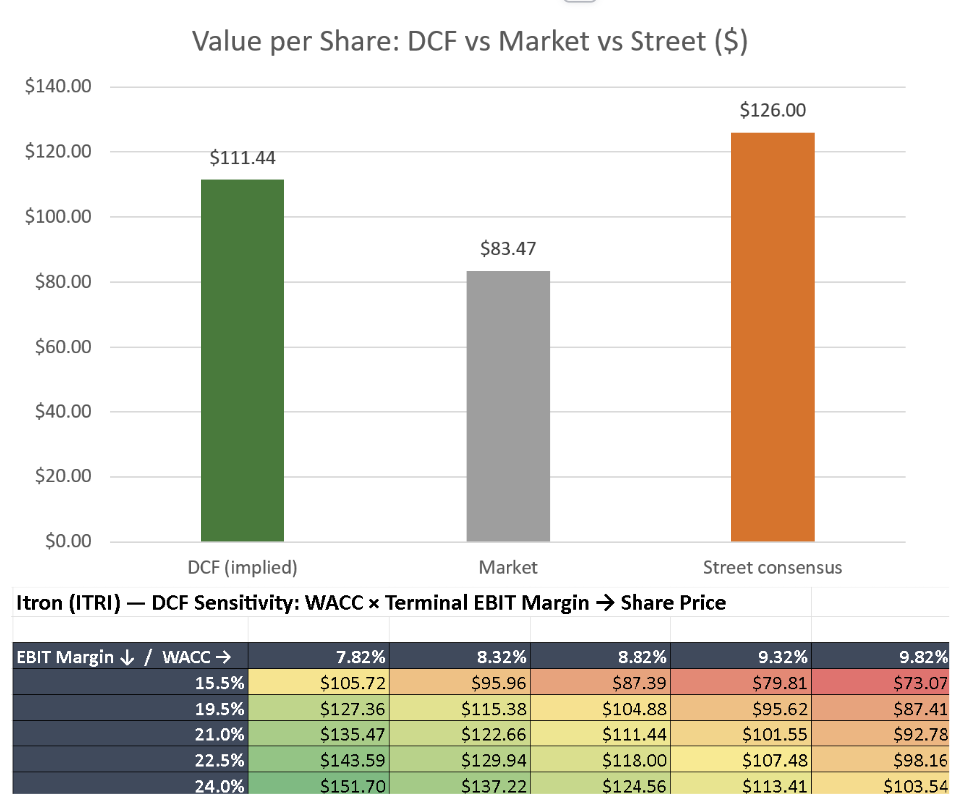
Our 10 year DCF model projects Itron’s share price at ~$111 a share, representing ~33% upside. This base case represents the forecasted transition of Itron from primarily a utility hardware firm into a software / hardware mix shift, which we forecast will lift margins slightly under best-in-class, while maintaining strong growth. The market is not fully recognizing the ability of Itron to expand operating margins with its software applications, and does not properly take into account software expanding its share of total revenues long-term.
2. Approach
We constructed a 10 year forecast free-cash-flow-to-firm DCF off the FY2025 operating base with a current balance sheet as of Q1 2026 numbers. This intrinsic valuation is based on cash flows, not multiples or peer comparisons, to adequately represent the transition of Itron from a majority hardware business into a mix between high-margin software solutions and the underlying hardware business.
3. The drivers
Revenue growth.
Our model assumes a long-term TGR of 2.5%, a measure that does not have a disproportionate effect on overall share price due to ROIC eventually fading to WACC, largely nullifying the effect of TGR on the model. We do not assume that Itron can out-grow the economy in the long term, so TGR at 2.5% sits below nominal GDP growth of roughly 3.8% and above long-term inflation of ~2%. We assume that revenue growth averages a 8.2% increase per year, going from increases of 1% and 12.5% in 2026 and 2027 respectively, to 6% in 2035. We assume that grid modernization, electrification and data-center load, the $4.5B backlog and water infrastructure investment will be consistent and profitable long-term revenue drivers. This CAGR of 8.2% is one of the more aggressive assumptions within the valuation, and is consistent with our assumptions of the ability of Itron to change composition of recurring revenue by shifting more toward software solutions. Thus, Outcomes and Resiliency are expected to grow significantly, while hardware will likely remain closer to historical revenue growth averages of flat to slightly downward.
Operating margin
EBIT margins are forecasted to expand from ~15% in 2026 to 21%. This assumes that operating margin is driven by revenue mix-shift to higher margin software applications, with margins landing around software / hardware mix competitor badger meter, leaving plenty of upside if software revenue share accelerates faster than expected. Blended gross margins are expected to expand from 38% in 2026 to 44% in 2035, anchored to a 37.7% base year-gross margin. ARR growth rate is forecasted to fade from 21% in 2026 to 9% in 2035. This assumption is based on Itron’s recent ARR increase of 28% YoY, representing the transition of the firm into software solutions, which historically maintain much higher growth rates, typically in the mid to low double digits, than utility or hardware firms. This drives Itron’s recurring and nonrecurring gross margins. We forecast recurring gross margins to expand from ~38% to ~54%, and non-recurring gross margin is expected to grow from ~40%. Recurring share is expected to grow to 28% of total revenues, representing a change from the ~80% hardware-driven firm today, to a software/hardware mix in the long term, where Itron settles out at a higher ratio of hardware to software. This is a reasonable outcome given the nature of Itron’s software expansion path compared with the historical performance of the firm itself and its peers.
Reinvestment.
To properly include acquisition and other intangible growth drivers, reinvestment was used in our model over a traditional CapEx forecast, as represented in a sales-to-capital ratio of 1.35. This factors profitability from software application revenue mix-shift, while considering the historical fluctuation of the ratio within the 1.2 to 1.4 range.
Cost of capital.
We determined a Weighted Average Cost of Capital of 8.82%. Pre-tax cost of debt of 6.1% was determined through a risk-free rate of 4.37% + a credit spread of ~1.7%, credit spread derived by considering Itron’s BB rating. The risk free rate was derived from the current 10 year US treasury yield, and beta of 1.22 is the Blume-adjusted version of Itron’s raw trailing beta. Market risk premium is a weighted average of Damodoran’s implied-ERP figures and IESE Expert Risk Survey numbers, which came out to around ~5%. Tax rate of 22.0% is derived from Itron’s normalized non-GAAP effective long-term tax rate of 22%. We considered a 30-day average of daily Treasury yield curve rates on 10-year Treasury bonds in our risk-free rate estimate, which resulted in a risk-free rate of 4.41 percent.
5. Scenarios and expected value
According to 13 analysts polled by S&P Global, Itron stock has a consensus rating of "Buy" and an average price target of ~$126. Our value of $111 represents a slightly more conservative approach on 8.82% WACC and our ROIC-fades-to-WACC terminal assumption, while leaving headroom for rapid margin expansion that could very realistically occur given the high profitability of Itron’s software solutions segments.
5. What the market is pricing
The market assumes that Itron's terminal EBIT margin will linger around ~14.6%, implying that Itron's margins will stagnate long term. Itron is currently operating with an EBIT margin of 14.5%, and to assume that stagnates completely ignores the upside that comes with Itron's going transition into a software / hardware mixed firm. Additionally, the market may be pricing in short-term uncertainties regarding the Urbint and Locusview acquisitions, and largely ignoring the tangible long-term growth prospects that come with Itron's revenue mix-shift in regard to software applications.
6. Risks and assumptions
- —Revenue mix shift slows and Operating Margins stagnate
If software growth disappoints relative to our assumptions, we are overstating the value of the firm. Our ARR growth fade from 21% to 9% over 10 years may be too optimistic.
- —We are underestimating WACC
If Itron’s cost of debt is understated by our model in the long term, or the market risk premium we are assuming is too low, the WACC of 8.82% is overstating the value of the firm. Assuming a 9.32% WACC, driven from higher market risk premiums and a higher cost of debt than our assumptions, implied share price falls near current levels of ~$80
- —ARR Growth Rate fade is overestimating the effect of software on Itron
It is entirely possible that Software and related applications do not continue growth at expected rates. If so, that would have a significant effect on software related revenues as a share of total revenues, having a large impact on long-term revenue growth and EBIT margins. This would have a large effect on the valuation of the firm, as our numbers are highly sensitive to long-term EBIT margins and the projected revenue mix shift.
Slackline Capital research is published for portfolio transparency. Published July 7, 2026. Not investment advice.